
আরও দেখুন


 17.04.2026 04:26 AM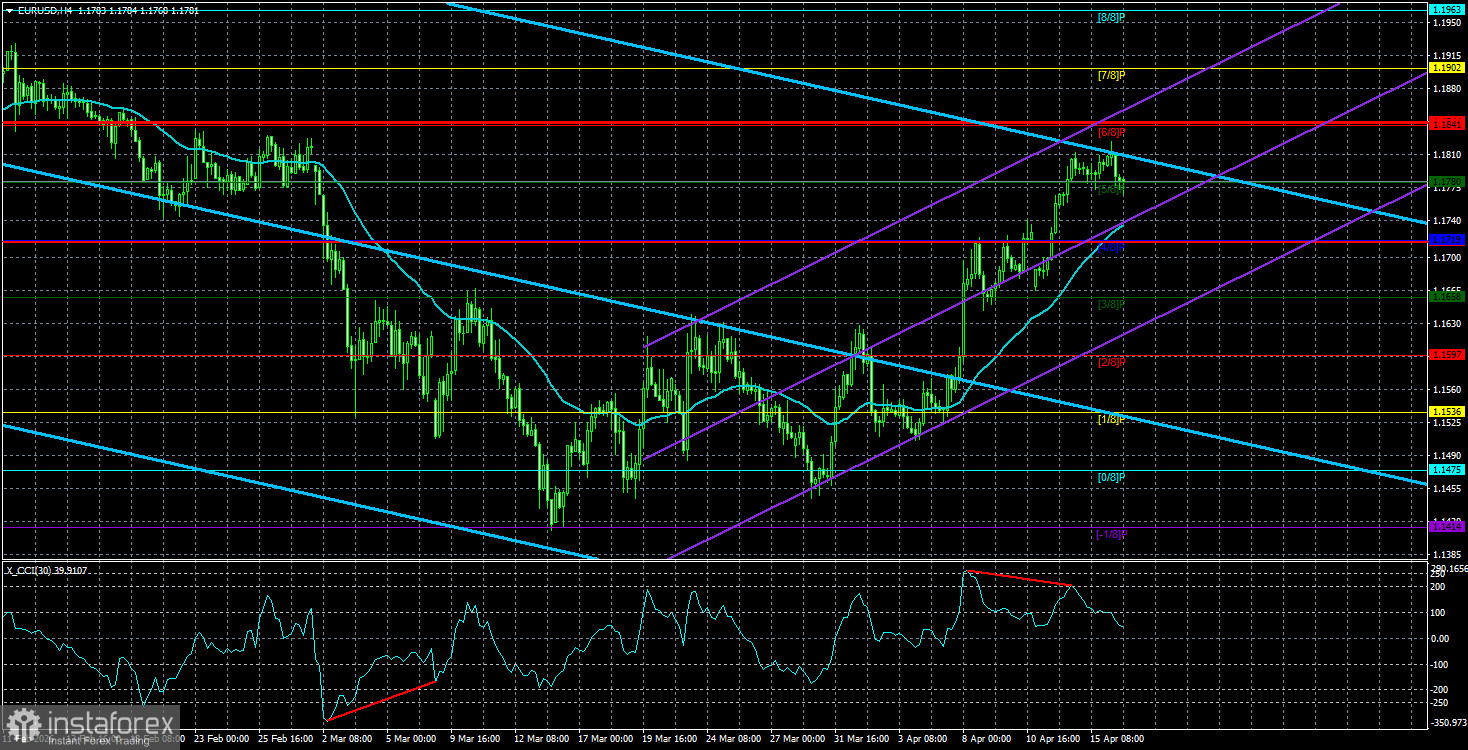
The EUR/USD currency pair traded with very low volatility on Thursday for the third consecutive day. What is causing the pause in the market? In our opinion, it is due to the absence of news—macroeconomic, fundamental, or geopolitical. Initially, there were very few macroeconomic reports planned for this week. We have no confusion about the market's lack of reaction to secondary indicators such as industrial production or jobless claims. Among the fundamental events this week were the speeches of Christine Lagarde and Andrew Bailey, but the market reacts not to the fact that central bank heads are speaking but to their statements. If no important statements were made, there is no reaction.
The geopolitical factor has weakened its influence on the currency market, yet it remains a key factor. Let us explain what we mean. Traders and investors have been actively buying the U.S. dollar for over a month. Why? Because the situation in the Middle East has shifted from stable to alarming. Almost every day, the parties to the conflict have struck critical infrastructure, leading to drops in oil and gas production and, consequently, shortages of energy resources on global markets. Additionally, investors began to flee the Middle East, as staying in Dubai became unpleasant amid rocket and drone attacks. Shortly thereafter, Iran blocked the Strait of Hormuz, worsening the oil situation. It was against this backdrop that the dollar rose almost every day.
Also noteworthy is Donald Trump's persistent belligerent rhetoric, as he has repeatedly vowed to destroy Iran and hinted at the use of nuclear weapons. What happened two weeks ago? Trump unexpectedly announced negotiations with Iran and a two-week ceasefire. Although the ceasefire was violated on the very first day, all parties to the conflict ceased hostilities, and the silence is still maintained. The Strait of Hormuz remains blocked, but this has not worsened the oil situation. Moreover, Washington and Tehran do not deny the possibility of resuming talks and reaching an agreement. As a bonus, Trump now speaks daily about peace, deals, and the end of the war.
Thus, there is no negative news; although the situation in the Middle East remains quite tense, the participants in the conflict have embarked on a path of de-escalation and have at least ceased the destruction of critical infrastructure in the region. Therefore, the dollar has not been in demand for two weeks. All who were fleeing from risks have already done so. In the past two weeks, there has been nothing to flee from, as the situation promises to improve soon.
We continue to believe that the events in February and March in the Middle East were somewhat of a gift to the dollar. When the next such gift will be received is unknown. We believe that the trends of 2022 and 2025 will resume.
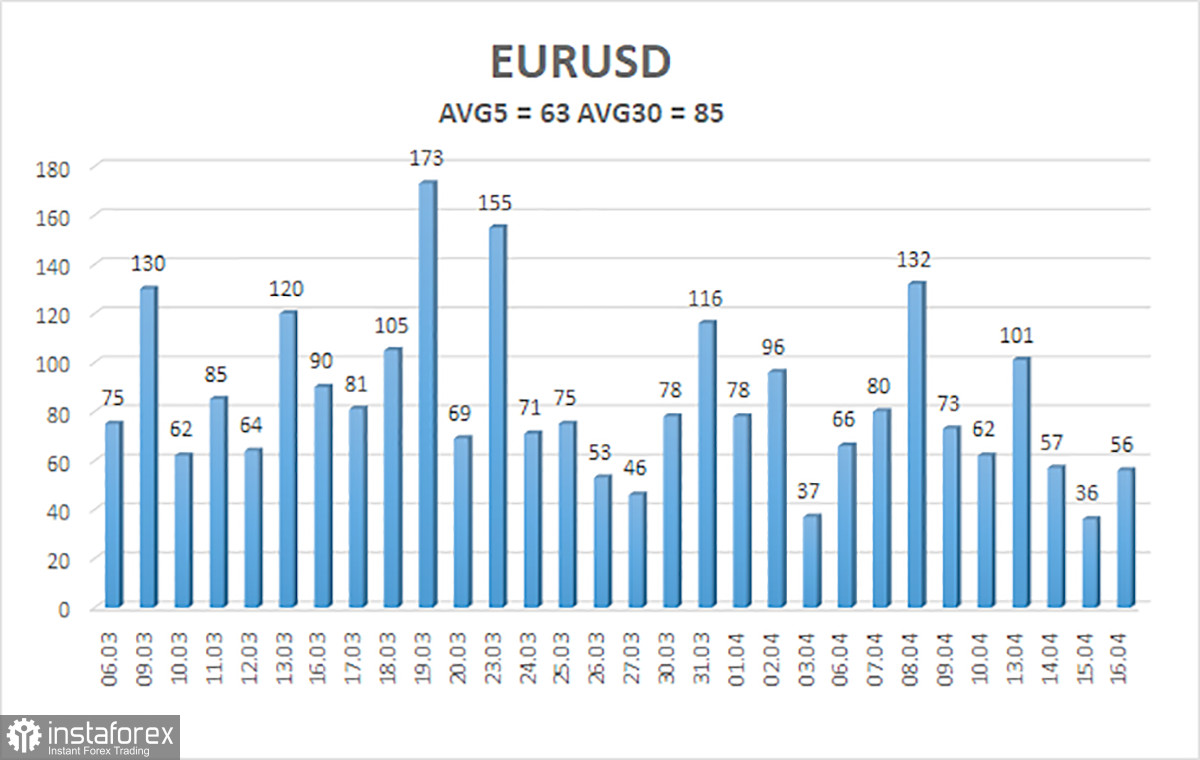
The average volatility of the EUR/USD currency pair over the last 5 trading days as of April 17 is 63 pips, characterized as "average." We expect the pair to trade between 1.1718 and 1.1844 on Friday. The upper channel of the linear regression has turned downward, indicating a potential trend change to a bearish one. However, in reality, an upward trend may resume at this time. The CCI indicator has entered the overbought area and formed a "bearish" divergence, warning of a possible downward pullback in the near future.
S1 – 1.1780
S2 – 1.1719
S3 – 1.1658
R1 – 1.1841
R2 – 1.1902
R3 – 1.1963
The EUR/USD pair has begun its upward movement, but its continuation will again depend on geopolitics. The global fundamental backdrop for the dollar remains extremely negative; therefore, in the long term, we still expect the pair to grow. If the price is below the moving average, short positions can be considered with targets at 1.1658 and 1.1597. Above the moving average line, long positions remain relevant with targets at 1.1841 and 1.1902. The market is gradually distancing itself from the geopolitical factor, and familiar economic factors are starting to take center stage.
Regression channels help determine the current trend. If both are directed in the same way, it indicates a strong trend.
The moving average line (settings 20.0, smoothed) defines the short-term trend and direction in which trading should proceed.
Murray levels serve as target levels for movements and corrections.
Volatility levels (red lines) indicate the probable price channel in which the pair is likely to trade over the next day, based on current volatility readings.
The CCI indicator's entry into the oversold area (below -250) or the overbought area (above +250) indicates that a trend reversal in the opposite direction is approaching.


