
See also


 12.03.2026 01:06 PM
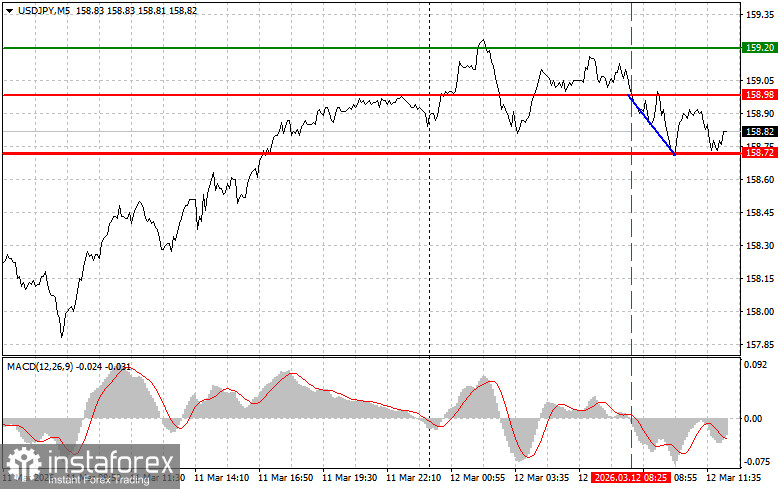
The test of the 158.98 level occurred when the MACD indicator had just begun moving downward from the zero line, confirming a correct entry point for selling the dollar. As a result, the pair declined to the target level around 158.72.
The absence of dollar buyers above 159 yen indicates the risk of possible intervention by the Bank of Japan. For this reason, if you are betting on a rise in the dollar, it is better to consider buying on corrections, rather than above the 159 level.
The chances that the USD/JPY pair will decline are currently higher than the chances of a new rapid rise toward 160. Strong reasons would be required for such a move.
On the other hand, today's U.S. economic data could provide those reasons. Market participants will primarily focus on initial jobless claims, which are published weekly and serve as one of the most timely indicators of the condition of the U.S. labor market. Data on the trade balance will also be important. At the same time, reports on building permits and housing starts in the United States will be released.
However, the main driver of USD/JPY movements remains geopolitics and the situation in the Middle East.
As for the intraday strategy, I will mainly rely on Scenario No. 1 and Scenario No. 2.
Buy Signal
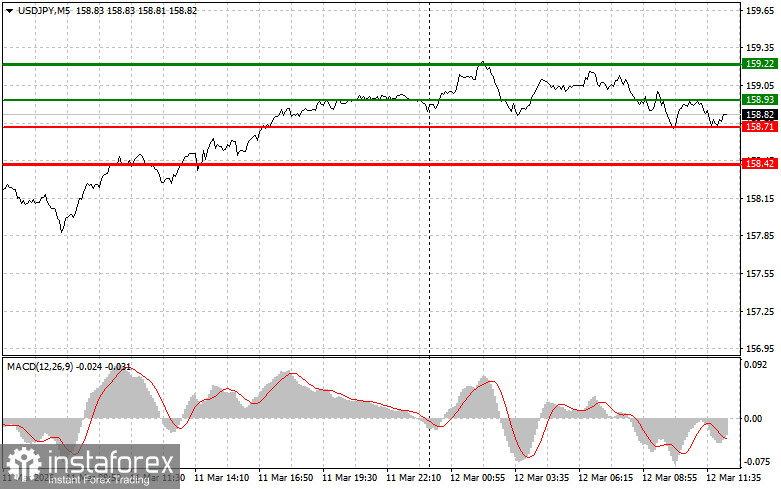
Today I plan to buy USD/JPY when the price reaches the entry point around 158.93 (green line on the chart), targeting a rise to 159.22 (thicker green line on the chart). Near 159.22, I plan to exit buy positions and open sell positions in the opposite direction, expecting a 30–35 point move downward from that level. A rise in the pair can be expected today after strong U.S. economic data.
Important: Before buying, make sure the MACD indicator is above the zero line and just starting to rise from it.
I also plan to buy USD/JPY if there are two consecutive tests of the 158.71 level while the MACD indicator is in the oversold zone. This would limit the pair's downward potential and could trigger a market reversal upward. In this case, growth toward 158.93 and 159.22 can be expected.
Sell Signal
I plan to sell USD/JPY after the 158.71 level is broken (red line on the chart), which could lead to a rapid decline in the pair. The key target for sellers will be 158.42, where I plan to exit sell positions and immediately open buy positions in the opposite direction, expecting a 20–25 point rebound. Pressure on the pair may return today if U.S. data comes out very weak.
Important: Before selling, make sure the MACD indicator is below the zero line and just beginning to move downward.
I also plan to sell USD/JPY if there are two consecutive tests of the 158.93 level while the MACD indicator is in the overbought zone. This would limit the pair's upward potential and could lead to a downward market reversal. In this case, a decline toward 158.71 and 158.42 can be expected.
What the Chart Shows
Important
Beginner traders in the Forex market should make entry decisions very carefully. Before the release of major fundamental reports, it is best to stay out of the market to avoid sharp price fluctuations.
If you decide to trade during news releases, always place stop-loss orders to minimize potential losses. Without stop-loss orders, you may lose your entire deposit very quickly, especially if you do not use proper money management and trade with large volumes.
Remember that successful trading requires a clear trading plan, similar to the one presented above. Making spontaneous trading decisions based solely on the current market situation is generally a losing strategy for an intraday trader.


