
Lihat juga


 29.07.2026 05:51 PM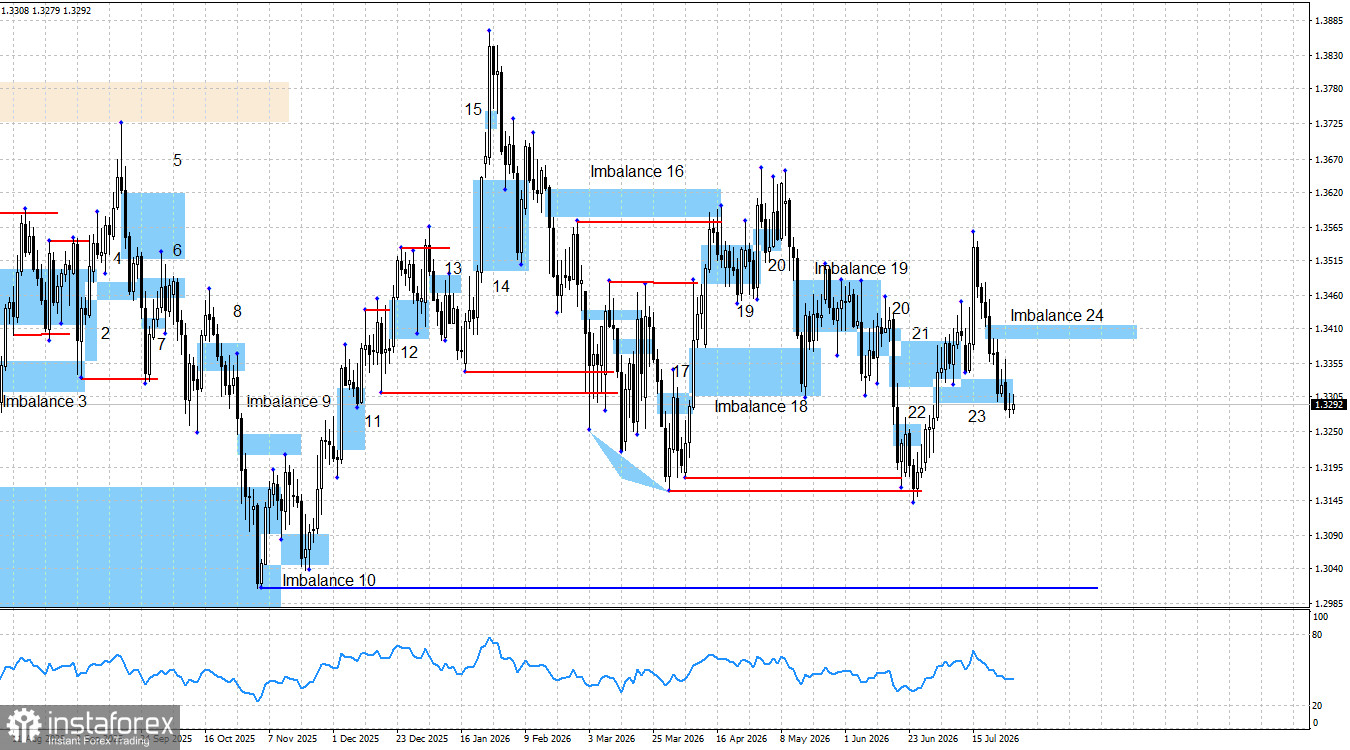
The GBP/USD pair posted strong gains in recent weeks, which may mark the beginning of a bullish trend. However, the pound is currently undergoing a corrective pullback that began two weeks ago and has yet to run its course. Last week, the fundamental backdrop was not unfavourable for the pound, yet the bears remained on the offensive throughout the week. This week, the decline in the pound has continued despite the absence of any negative news from the UK, while the only major US report disappointed. Unfortunately, Bullish Imbalance 23 failed to halt the bearish advance, although I previously noted that a third reaction to the same pattern would be highly unusual.
This evening, the results of the FOMC meeting will be announced, followed tomorrow by the Bank of England's policy decision. Both events are likely to generate significant volatility, and neither outcome can be predicted with certainty. More precisely, both central banks are expected to leave monetary policy unchanged, but traders understand that any wording change or hint from Andrew Bailey or Kevin Warsh, as well as any new language in the policy statements, could trigger a substantial market move. Should the pound expect support from the Bank of England? In my view, the answer is no. The latest UK inflation report for June showed a slowdown to 2.6% year-on-year. There is little reason for the Bank of England to tighten monetary policy when inflation is already easing without additional restrictive measures. As a result, the situation for the pound could deteriorate further on Thursday, allowing the bulls to continue losing ground.
Last week, oil prices climbed to $100 per barrel, while the consequences of renewed escalation in the Middle East and the blockade of the Strait of Hormuz could push prices as high as $120. If events develop according to the most pessimistic scenario, oil prices are likely to continue rising and surpass the highs recorded between March and May. In that case, inflation in both the United States and the United Kingdom could begin accelerating again. Conversely, if the situation develops more favourably, oil prices could return to the $60–70 per barrel range. Under those circumstances, further Fed tightening may prove unnecessary, while the Bank of England is already no longer facing a significant inflation problem. Therefore, the US dollar cannot yet rely on the Fed's hawkish stance as firm support, but the pound likewise lacks support from its own central bank.
Technical analysis indicates that the bulls' advance unexpectedly gave way to renewed bearish pressure. No bearish patterns or technical signals were formed before the decline began. The bulls' only remaining support—Bullish Imbalance 23—has failed. As a result, the bears have regained control of the market, and Bearish Imbalance 24 now provides the primary area from which short positions may be considered. There are currently no other technical patterns.
There were no significant economic releases on Wednesday. Therefore, all that remains is to await the outcome of the Fed meeting and Kevin Warsh's press conference, along with the market reaction that follows.
The broader fundamental backdrop still leads me to expect continued US dollar weakness over the longer term. Even the conflict between Iran and the United States has not changed that outlook. The possibility of Fed rate hikes in 2026 has not altered it either. Geopolitical tensions reminded the market of the dollar's safe-haven status for several months, but the conflict has already moved beyond its most active phase. The Fed intends to raise interest rates in 2026, which is supportive for the dollar. However, it should not be forgotten that tighter monetary policy is likely to slow both economic growth and the labour market. Moreover, Kevin Warsh was appointed by Donald Trump to lead the FOMC in order to pursue a more accommodative monetary policy—something Jerome Powell was perceived as unwilling to deliver. Therefore, in my opinion, any appreciation of the US dollar is likely to be temporary rather than sustainable.
The economic calendar for July 30 contains seven scheduled events, with the Bank of England meeting and Andrew Bailey's speech expected to be the key highlights. As a result, the economic backdrop may have a strong influence on market sentiment throughout Thursday.
From a long-term perspective, the outlook for the pound remains bullish, although the bulls have so far been unable to launch a sustained advance. After liquidity sweeps below the last two swing lows, the bulls mounted a solid rally, but the bears unexpectedly regained control without any obvious catalyst. Consequently, GBP/USD may continue declining towards 1.3007, the level that would invalidate the broader bullish trend.
However, this move would require new bearish technical signals, which are currently absent. For the bears, the 1.3392–1.3415 level remains crucial, as it contains Bearish Imbalance 24. Short positions should only be considered within this imbalance zone. At present, the bulls have no meaningful technical signals in their favor.


