
Lihat juga


 04.08.2026 06:21 PM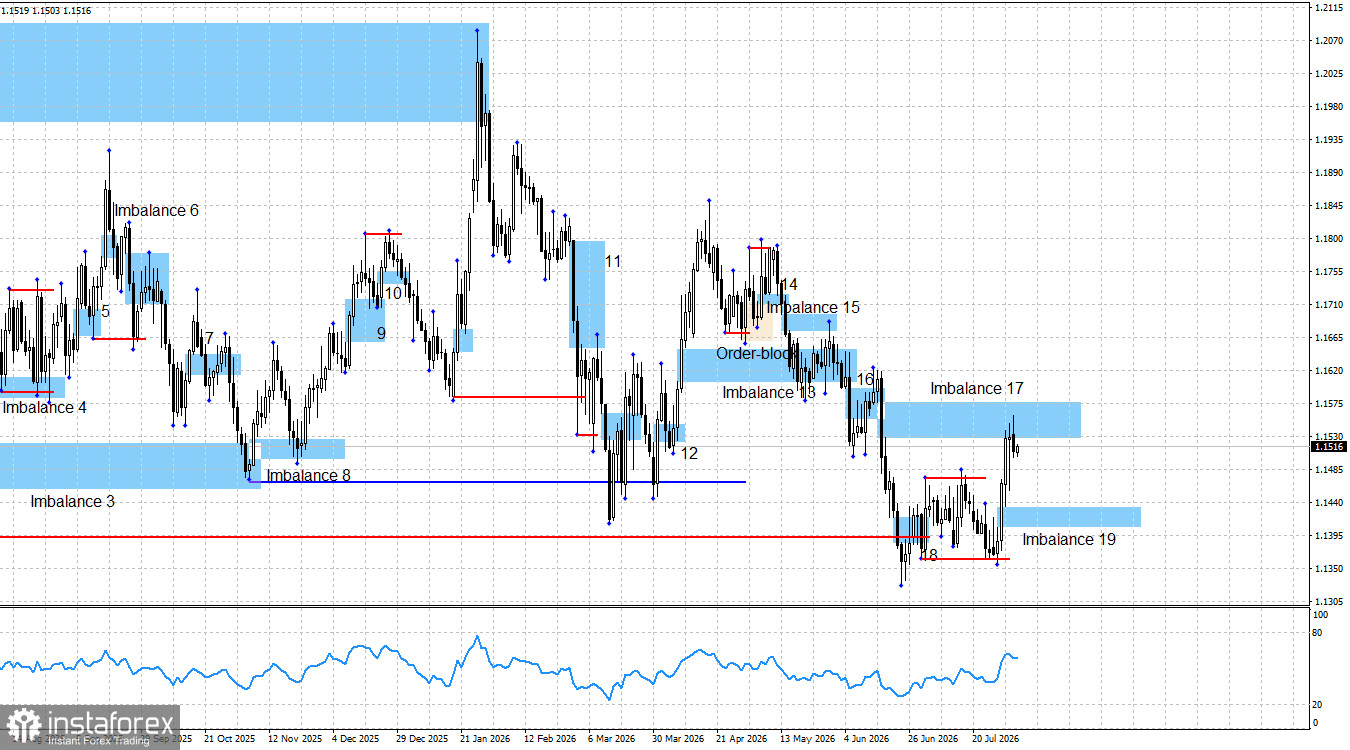
The EUR/USD pair remains within the local bearish impulse that has been in place since April 17. However, every impulse eventually comes to an end, and who is to say that this one has not already ended? It is worth remembering that imbalances tend to work best within the same impulse. If an imbalance forms during a bearish trend but is tested after the market has already shifted into a bullish trend, the resulting price reaction may be very limited. At present, the reaction to Imbalance 17 has been weak, while the British pound has already responded to a bullish imbalance and may continue its upward move, which currently looks much more convincing than the euro's.
The fundamental backdrop is also not in the bears' favor. Last week, traders expected Kevin Warsh to deliver either a clear indication of a September rate hike or, at the very least, more hawkish rhetoric that would answer one key question: Is the Federal Reserve preparing to tighten monetary policy this autumn? Instead, Warsh referred to incoming economic data, and as we know, the latest U.S. labor market figures were relatively weak. As a result, he may argue in September that labor market conditions remain too soft for the Federal Reserve to focus solely on inflation. Economic data have also favored the euro, as U.S. GDP figures disappointed while Eurozone GDP data exceeded expectations. This week, the Nonfarm Payrolls (NFP) report and the U.S. unemployment rate could prompt another retreat by the bears.
It is also worth remembering that expectations of Federal Reserve monetary tightening remain only expectations. They can change rapidly in response to geopolitical developments or incoming economic data. Recent U.S. labor market reports have been weak, while inflation data have pointed to slowing price growth. Together, slowing labor market momentum and easing inflation cast doubt on the likelihood of an FOMC rate hike in the foreseeable future. Personally, I am not convinced that the Federal Reserve will necessarily begin tightening monetary policy this year.
Geopolitical developments have moved into the background for traders, but they continue to influence the global economy. Tehran and Washington remain unable to reach an agreement and have not even returned to the negotiating table. Donald Trump continues to claim that agreements on the Strait of Hormuz and Iran's nuclear program are close, but developments on the ground suggest otherwise. Tehran continues to reject Trump's optimistic statements, indicating that no meaningful negotiations are currently taking place. As a result, there can be no agreement. The unresolved geopolitical conflict continues to support energy prices, which in turn keeps inflation elevated across many economies. In my view, the ongoing conflict between Iran and the United States is no longer sufficient on its own to trigger another major bearish advance.
From a technical perspective, the current chart structure still points to the bearish impulse that began on April 17. Bearish Imbalance 17 has already been tested, but the market's reaction has been relatively weak. The key question is whether the euro's decline actually ended last Friday. Last week also saw the formation of a new Bullish Imbalance 19, giving buyers renewed reason for optimism. Consequently, the pair could decline toward Imbalance 19, where a new buy signal may emerge. However, the euro is not required to revisit Imbalance 19. It should be viewed only as a potential area of interest rather than a mandatory downside target.
Tuesday's economic calendar was relatively light. The only notable release—the U.S. JOLTS report—failed to generate enough interest to trigger significant buying or selling of the U.S. dollar. The market continues to await more important labor market and unemployment data.
The bulls still have plenty of reasons to remain optimistic in 2026, and even the conflict in the Middle East has not fundamentally altered that outlook. From both a structural and long-term perspective, the policies implemented by Donald Trump—which contributed to the dollar's sharp decline last year—have not materially changed. Despite the FOMC's hawkish bias, I still see few compelling factors supporting the U.S. dollar. Nevertheless, sellers continue to dominate for now, while no confirmed bullish signals have yet emerged.
Economic Calendar for the United States and the Eurozone
United States
The economic calendar for August 5 includes two important releases. The ADP Employment Change report is the first major indicator of U.S. labor market conditions this week, while the ISM Services PMI is an important economic indicator in its own right. As a result, macroeconomic data could influence market sentiment during the second half of Wednesday's session.
EUR/USD Forecast and Trading Tips
In my view, the pair remains in the process of forming a broader bullish trend. Although the news backdrop shifted sharply in favor of the bears five months ago, the longer-term uptrend cannot yet be considered invalidated. Consequently, buyers may launch another advance after liquidity was taken from the two most recent clearly defined swing lows.
A sell signal could still emerge within Imbalance 17, meaning the euro may begin to decline this week toward Imbalance 19. However, such a move would also require a supportive fundamental backdrop for the U.S. dollar. A bullish signal may then develop within Imbalance 19, allowing traders to consider long positions with targets above 1.1620. At the same time, the broader uptrend could resume even without the pair revisiting Imbalance 19.


