
یہ بھی دیکھیں


 14.05.2026 02:25 PM
Today, all traders' attention for EUR/USD is focused on Beijing. For the first time in eight years, US President Donald Trump arrived in China on an official visit for talks with President Xi Jinping.
The event is, unquestionably, not a trivial matter. Journalists are dissecting even the smallest details: notably, the fact that Trump failed to seize the initiative in the handshake with Xi (the US president attempted to pull his hands toward himself, but the Chinese leader matched his motion) became a subject of global media attention.
If such minute details are under the microscope, the first statements of the leaders are being examined by the market under an actual magnifying glass. Every word carries weight; every phrase and rhetorical turn matters, including for EUR/USD traders.
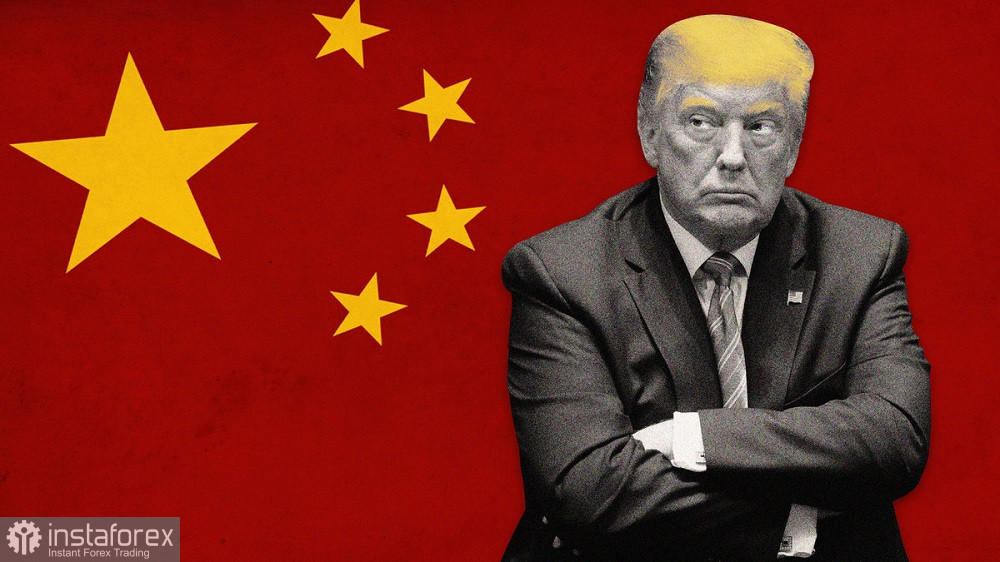
The superpower leaders have already completed the first round of bilateral talks, which lasted more than two hours. Following that meeting, Xi Jinping said the countries should be partners, not rivals, stressing the need for stability. Trump, in response, called Xi a great leader and a friend, expressing hope for a "fantastic future in relations.
Yet, according to major international media, the Trump-Xi meeting was positive and businesslike but not groundbreaking—without major final agreements or abrupt shifts.
At the same time, the Chinese leader warned the US president about the risk of a direct conflict if the Taiwan issue is handled improperly. As Bloomberg reports, such remarks by Xi somewhat clouded the friendly atmosphere of the meeting. The Associated Press was even harsher, suggesting the US president in Beijing uttered platitudes, while Xi Jinping openly and directly warned of possible confrontation. In particular, when discussing Washington's approach to Taiwan, Xi mentioned the Thucydides trap — the risk of war or sharp escalation when a rapidly rising power challenges a dominant one — while stressing that conflict should not be regarded as automatic or inevitable. Xi's stern tone sharply contrasted with Trump's demeanor, who praised his Chinese counterpart and said it was an honor to be his friend. When asked whether the Taiwan case had been discussed during the meeting, however, the US president preferred not to answer.
Analysts estimate that such a marked contrast in rhetoric indicates a substantive distance between the leaders on key strategic issues (US relations with Taiwan, the Middle East conflict, and trade disputes). According to AP, the Trump-Xi meeting is more of a political show and a symbolic gesture than a sign of a serious breakthrough.
Other observers believe Donald Trump will seek a quick and loud economic victory (for example, expanding Chinese purchases of US agricultural products) ahead of the midterm congressional elections in November. China, by contrast, is playing a much longer game, where the objective is not a one-off deal but a gradual and systematic easing of US tariff pressure. Thus, the leaders' meeting looks like a clash of different approaches and goals. On one side is the urge to solve short-term political tasks; on the other is long-term logic and the construction of a more stable balance of power.
These assessments currently dominate the global media.
At the same time, official Iranian representatives significantly hardened their rhetoric toward the United States. In particular, Foreign Minister Abbas Araghchi today publicly called to end American despotism and send it to the rubbish bin of history. Such harsh statements indicate that the negotiating window between the US and Iran is narrowing, and the risk of further escalation remains high.
Against this ambiguous fundamental backdrop, EUR/USD is under pressure, but still holding within the 1.17 figure. Yesterday sellers tried to approach the main support at 1.1690 (the middle line of the Bollinger Bands indicator on the weekly chart) but stopped at 1.1696 and closed the trading day at 1.1711. Today the pair is drifting at the base of the 1.17 figure.
In my view, the so-called "Xi factor" is unlikely now to form a sustainable trend—the market reacts to rhetoric faster than to real agreements or non-agreements. In such conditions, price moves driven by headlines are mostly emotional in nature and, as a rule, are later partially or fully corrected.
Therefore, at present, it is advisable to keep a wait-and-see position on EUR/USD. First, Trump's visit to China is not yet finished, and negotiations continue. Second, under these circumstances it is wiser not to trade the news in the moment but to wait for the market to digest them and to confirm a direction via dollar dynamics and risk assets. In other words, at this stage of the US-China saga it is sensible to stay out of the market.


