
یہ بھی دیکھیں


 12.10.2026 06:24 PM
The Elliott Wave count on the four-hour EUR/USD chart has become more complex. On the higher timeframe (lower chart), the downward trend segment has taken the form of a five-wave structure, A-B-C-D-E, which could be completed at any moment, as it appears reasonably well-defined. All waves within this segment are approximately equal in size, so I consider it corrective. If this assumption is correct, an impulsive upward trend segment will begin once the correction is complete, with targets well above the 1.2000 level.
On the lower timeframe (upper chart), an impulsive wave sequence continues to develop, which may belong to wave E of the higher timeframe. If this is indeed the case, then regardless of how strongly the dollar rises, its appreciation is approaching an end. A fifth wave within the downward structure may still form, as the current movement appears impulsive. Howeverwave , in either case, the current wave structure on both charts suggests that the downward sequence is nearing completion. News developments and a sharp shift in market sentiment have led to a substantial strengthening of the US currency, but the dollar is finding it increasingly difficult to continue rising.
The EUR/USD exchange rate fell by 20 basis points on Monday. Although this is a relatively small move, I would point out that the dollar has been rising almost every day, one way or another, for an entire month. Therefore, when another 20 points are added to an advance of 500 points, the move becomes significant. By all expectations, Monday should have been the quietest day of the week. However, the market found no reason to pause and resumed selling the European currency. After all, why wait when selling can generate profits? As a result, we once again saw no meaningful corrective wave, or else it would have to be examined under a microscope.
There was no significant news on Monday, apart from the farcical episode involving an energy ceasefire between Russia and Ukraine, which Donald Trump announced on Sunday. Markets were optimistic yesterday, but, like all previous attempts by Trump to end the conflict in Ukraine or the Middle East, this one ended in complete failure. Kyiv said on Sunday evening that it was hearing about an energy ceasefire with Russia for the first time, while Moscow stated on Monday that no such ceasefire was currently in place. It may be reached in the future, but doing so would require serious negotiations with Kyiv rather than a single post on Donald Trump's social media account.
Consequently, the US leader's statements once again had little to do with reality, while Kyiv and Moscow demonstrated that their positions do not depend on Washington's views. Personally, I wonder how much longer markets will continue to take Trump's statements seriously. Ninety percent of the US leader's statements have little connection to the actual situation on the ground. Meanwhile, EUR/USD continues to decline, even though there were no clear reasons for the move on Monday. Market participants did not wait for the US inflation report.
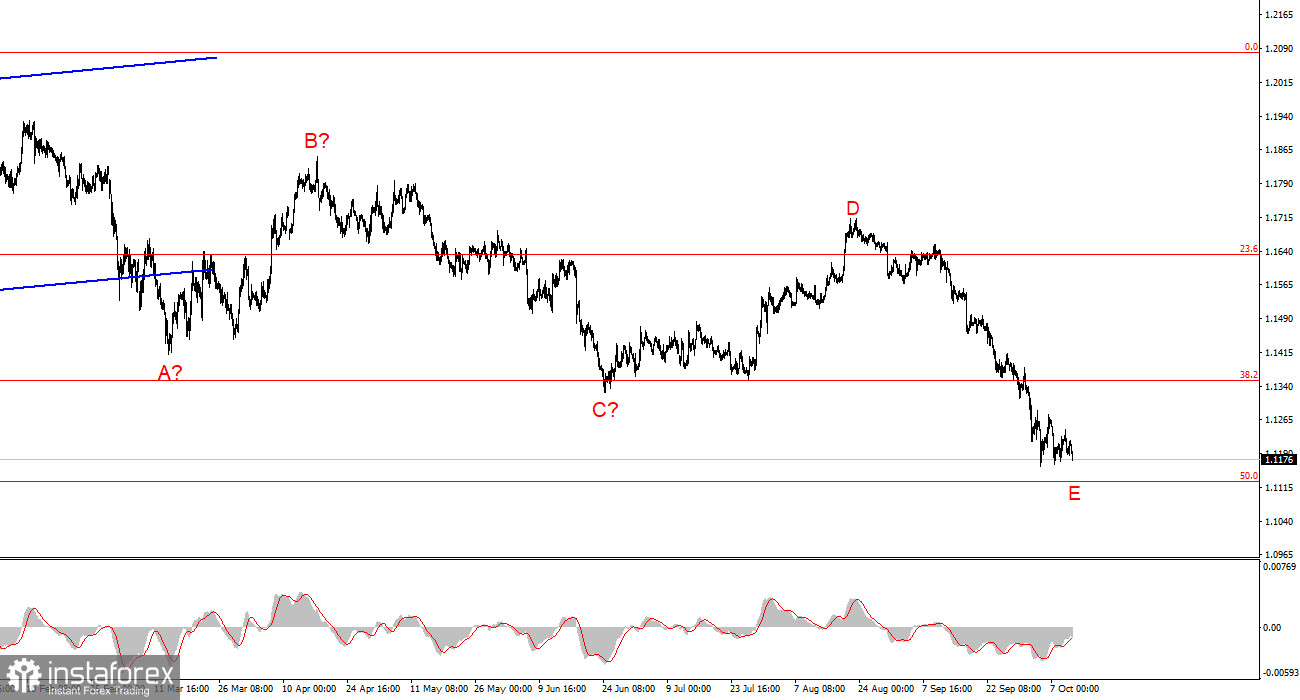
Based on my EUR/USD analysis, I conclude that the instrument remains within a global corrective trend segment labeled A-B-C-D-E. If this assumption is correct, the decline will continue, with targets below the low of wave C at 1.1325. I previously considered this scenario an alternative one, and had it not been for the Federal Reserve meeting, it would have remained a backup scenario. However, the Fed delivered a surprise, leaving the market with no alternative but to begin another wave of US dollar buying. Nevertheless, these purchases have continued for several weeks, even though no new factors are supporting the dollar. I would not open short positions in the current news environment; instead, I would prepare for a potential reversal.
On the higher timeframe, a downward trend segment is visible, taking the form of A-B-C-D-E. Therefore, EUR/USD may continue to decline below the low of wave C, while the internal wave structure of wave E may develop into a five-wave impulsive pattern.


