
Veja também


 12.10.2026 12:35 PM
The crypto market received another stress factor, and this time it involves the industry's largest exchange. The US Department of Justice is reviewing whether Binance complied with the terms of the agreement it signed in November 2023. If a breach is confirmed, the exchange could face the reinstatement of prior criminal charges and additional fines running into billions of dollars.

Recall how the 2023 episode ended. Binance pleaded guilty to violating US law, agreed to pay $4.3 billion and to strengthen compliance controls, and accepted three years of oversight by independent monitors. One condition of the agreement requires the company to report to authorities any evidence or allegations related to money laundering and sanctions evasion. It is precisely compliance with those obligations that the DOJ is now examining. Investigators want to know whether the exchange allowed transactions it should have blocked and thereby assisted in evading sanctions against Iran.
The trigger was events in September. According to media reports, on September 14 the US Attorney's Office for the Southern District of New York filed a civil forfeiture complaint for roughly $61 million in crypto that prosecutors say were proceeds from the illegal sale of Iranian oil. The complaint names two Chinese companies that used accounts on the exchange, but the exchange itself is not a party to the suit. Later, reports said accounts linked to Iranian financier Babak Zanjani moved about $850 million through the platform. Binance says it maintains a zero-tolerance policy on sanctions violations, continues to strengthen its controls, and is cooperating with law enforcement. In February 2026, the company also reported that its sanctions risk had fallen 96.8% from January 2024 through July 2025.
It is important to understand the stage of the matter. No new charges have been brought against Binance yet, no court has found that it violated sanctions after 2023, and the DOJ review remains at an early stage. So far the market has reacted calmly: BNB trades around $748 and initially rose on the first reports. This suggests investors are pricing in fines or tougher oversight rather than the return of criminal prosecution.
The broader context is clear: war with Iran makes sanctions a priority for Washington, and any major breach will be treated more harshly than in normal times. My base case: reinstating criminal charges in the coming weeks is unlikely, because the DOJ would need to prove management or employees knowingly aided sanctioned parties. A more probable outcome is an extension of oversight and new financial conditions. But the mere fact of a review turns Binance into a source of news risk against an already weak market, where spot ETFs lost nearly $1 billion in October and bond yields remain near multi-year highs. If confirmed findings of breach emerge in the coming days, I would expect significant pressure on BNB and a temporary outflow of funds from the exchange.
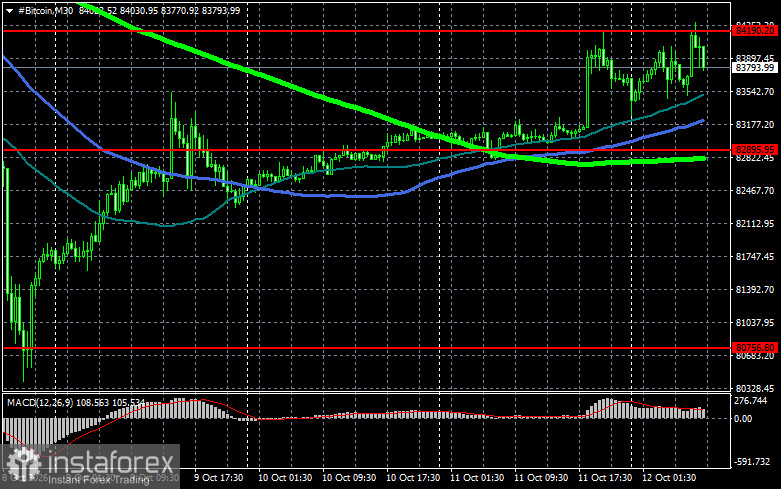
Technical picture for Bitcoin
Buyers are currently targeting a reclaim of $84,100, which would open a direct path to $86,000 and then toward $89,000; breaking $89,000 would signal attempts to restore a bull market. On the downside, buyers are expected at $82,800. A return of the trading instrument below that area could quickly push BTC toward $80,700. The most distant downside target is around $79,400.
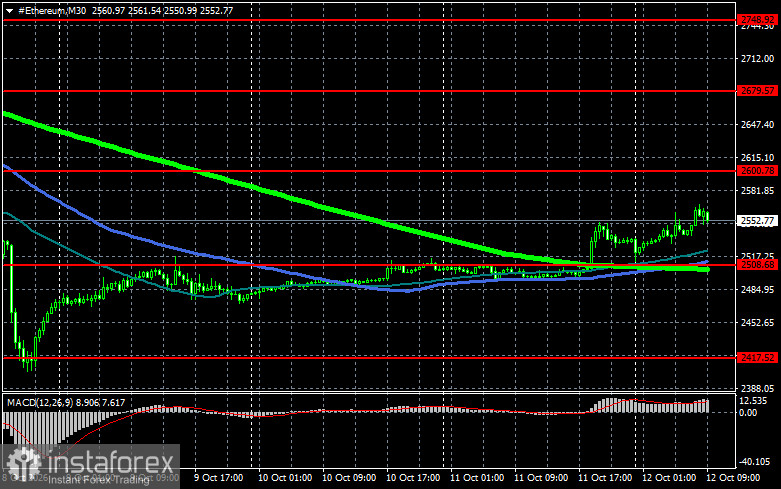
Technical picture for Ethereum
A clear hold above $2,600 would open a direct path to $2,679. The furthest upside target is the high near $2,748; breaking that level would indicate strengthening bullish sentiment and a return of buyer interest. On the downside, buyers are expected at $2,508. A return below that area could quickly push ETH toward $2,417. The most distant downside target would be around $2,348.
What we see on the chart:
- Red lines indicate support and resistance levels where either a price slowdown or active growth is expected;
- Green lines indicate the 50-day moving average;
- Blue lines indicate the 100-day moving average;
- Light green lines indicate the 200-day moving average.
A crossover, or a price test of moving averages, typically either halts the move or sparks fresh market momentum.


