
Veja também


 12.10.2026 04:38 PM
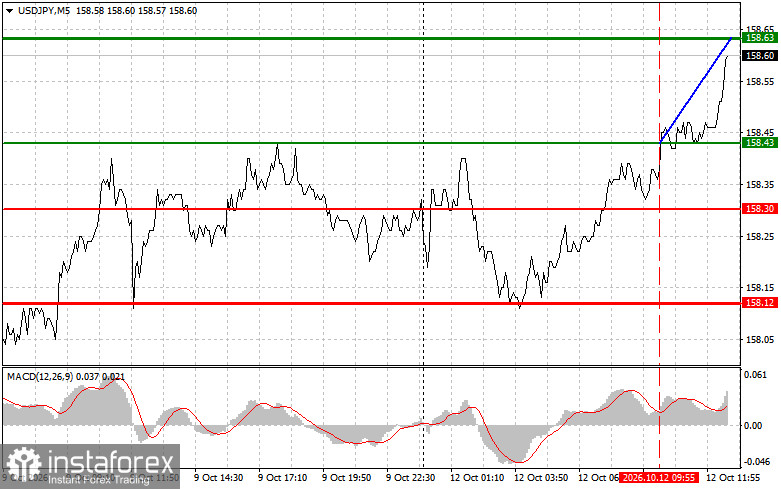
The test of 158.43 occurred when the MACD indicator had just begun moving upward from the zero line, confirming that the entry point for buying the US dollar was appropriate. As a result, the pair rose by more than 20 points.
The yen enters the second half of the day without its usual support from the United States. US markets are closed for Columbus Day, there are no economic data releases, and the only market cue will be a speech by FOMC member Beth M. Hammack. For USD/JPY, this likely means reduced trading activity and the possibility of brief price spikes in a thin market.
In my view, there is little prospect of a trend reversal. The US dollar remains in the lead, and the market continues to price in a Federal Reserve rate hike on December 9, with the probability estimated at around 80%. This continues to support the US currency. If Hammack confirms the Fed's hawkish stance, USD/JPY will receive additional support. If her tone is more cautious, the yen may recover some ground, but I do not expect a substantial correction.
As for the intraday strategy, I will focus primarily on implementing Scenarios No. 1 and No. 2.
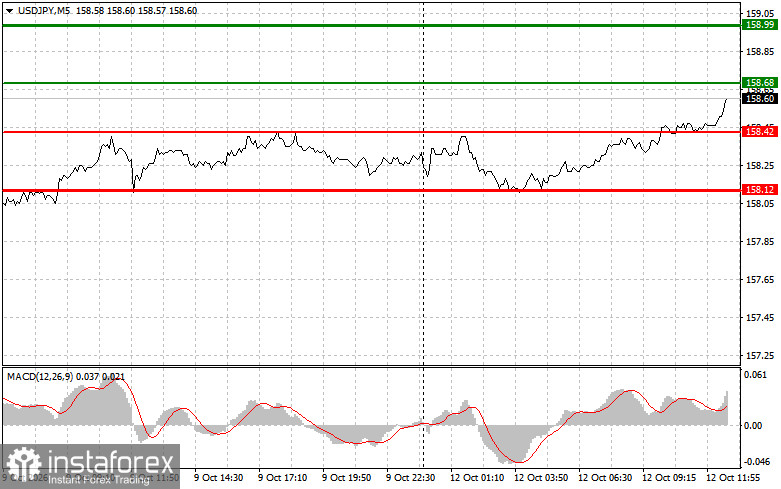
Scenario No. 1: Today, I plan to buy USD/JPY when the price reaches the entry level around 158.68 (the green line on the chart), targeting a rise to 158.99 (the thicker green line on the chart). Near 158.99, I plan to close the long position and open a short position, targeting a move of 30–35 points in the opposite direction from that level. A rise in the pair is possible today, but the upward potential appears limited. Important: Before buying, make sure that the MACD indicator is above the zero line and has only just begun moving upward from it.
Scenario No. 2: I also plan to buy USD/JPY today if the price tests 158.42 twice consecutively while the MACD indicator is in oversold territory. This would limit the pair's downward potential and trigger an upward reversal. A rise toward the next levels of 158.68 and 158.99 can then be expected.
Scenario No. 1: Today, I plan to sell USD/JPY after the price breaks below 158.42 (the red line on the chart), which could trigger a rapid decline in the pair. The sellers' main target will be 158.12, where I plan to close the short position and immediately open a long position, targeting a move of 20–25 points in the opposite direction from that level. Selling pressure on the pair may return today if the central bank intervenes. Important: Before selling, make sure that the MACD indicator is below the zero line and has only just begun moving downward from it.
Scenario No. 2: I also plan to sell USD/JPY today if the price tests 158.68 twice consecutively while the MACD indicator is in overbought territory. This would limit the pair's upward potential and trigger a downward reversal. A decline toward the next levels of 158.42 and 158.12 can then be expected.
Important: Beginner Forex traders should exercise great caution when making entry decisions. Before the release of major fundamental reports, it is generally best to stay out of the market to avoid sudden exchange-rate fluctuations. If you decide to trade during news releases, always place stop-loss orders to minimize losses. Without stop-loss orders, you can quickly lose your entire trading deposit, especially if you do not use proper money management and trade with large position sizes.
Remember that successful trading requires a clear trading plan, such as the one outlined above. Making spontaneous trading decisions based on current market conditions is a fundamentally flawed strategy for an intraday trader.


