
Vea también


 30.01.2026 09:02 AM
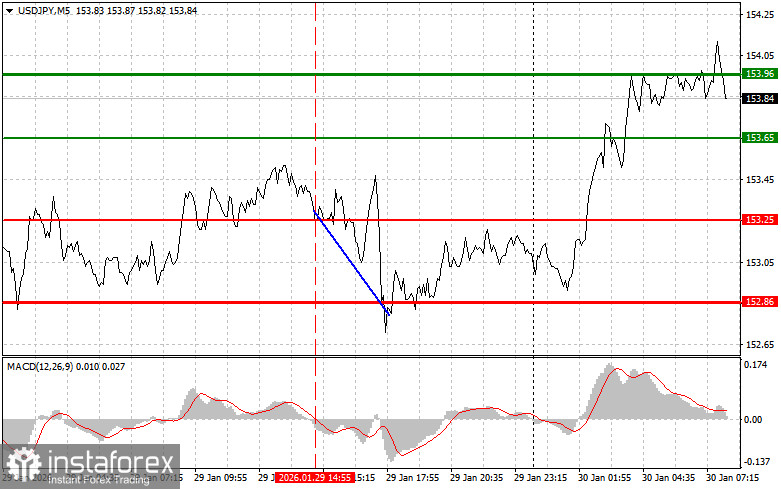
The test of the price at 153.25 coincided with the moment the MACD indicator was beginning to move downward from the zero mark, confirming the correct entry point for selling the dollar. As a result, the pair fell to the target level of 152.86.
The sharp drop in Tokyo's consumer price index from 2.0% to 1.5% triggered a sell-off of the yen and led to purchases of the US dollar. Traders, concerned about Japan's slowing inflation, see this as a signal that the Bank of Japan may delay or reconsider its plans to tighten monetary policy. This, in turn, makes yen-denominated assets less attractive, stimulating a capital outflow toward more profitable and stable currencies such as the US dollar. The dollar, bolstered by a sharp sell-off in the stock and metals markets, appears to be a more attractive haven amid global economic uncertainty.
Data also showed that Japan's unemployment rate remained unchanged at 2.6%. On one hand, this can be viewed as a sign of relative stability in the labor market. However, in the context of declining inflation, a stable unemployment rate is not sufficient to support the yen. Investors are more inclined to consider the aggregate economic factors, and the decline in inflation certainly outweighs employment stability. Furthermore, context matters. A 2.6% unemployment rate is not historically low. There are concerns that this may reflect a shortage of skilled labor and structural issues in the job market, rather than the economy's actual strength. In the coming days, the Bank of Japan's rhetoric will be crucial. If the central bank shows indecisiveness regarding tightening policy and continues to adhere to an ultra-easy approach, the yen is likely to continue weakening.
Regarding the intraday strategy, I will rely more on implementing Scenarios #1 and #2.
Scenario #1: I plan to buy USD/JPY today upon reaching an entry point around 154.15 (green line on the chart), targeting a move to 154.67 (thicker green line on the chart). At around 154.67, I intend to exit my long positions and open short positions in the opposite direction (expecting a movement of 30-35 pips back from that level). It is best to return to buying the pair during corrections and significant dips in USD/JPY. Important! Before buying, ensure the MACD indicator is above the zero mark and just beginning an upward move.
Scenario #2: I also plan to buy USD/JPY today in case of two consecutive tests of the price at 153.74 when the MACD indicator is in the oversold area. This will limit the downward potential of the pair and lead to a market reversal upwards. One can expect growth toward the opposite levels of 154.15 and 154.67.
Scenario #1: I plan to sell USD/JPY today only after the level of 153.74 (red line on the chart) is updated, which will lead to a rapid decline of the pair. The key target for sellers will be the 153.17 level, where I plan to exit my short positions and immediately open long positions in the opposite direction (expecting a move of 20-25 pips back from that level). It is better to sell as high as possible. Important! Before selling, ensure the MACD indicator is below the zero mark and just beginning its downward movement.
Scenario #2: I also plan to sell USD/JPY today in case of two consecutive tests of the price at 154.15 when the MACD indicator is in the overbought area. This will limit the upward potential of the pair and lead to a market reversal downwards. One can expect a decline to the opposite levels of 153.74 and 153.17.
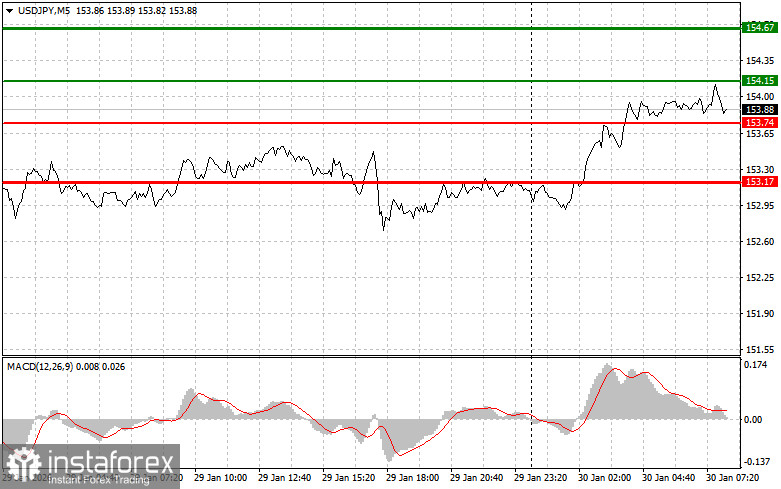
The thin green line represents the entry price at which one can buy the trading instrument;
The thick green line represents the approximate price where one can set Take Profit or secure profits, as further growth above this level is unlikely;
The thin red line represents the entry price at which one can sell the trading instrument;
The thick red line represents the approximate price where one can set Take Profit or secure profits, as further decline below this level is unlikely;
The MACD indicator: when entering the market, it is important to consider overbought and oversold zones.
Important: Beginner traders in the Forex market should be very careful when making entry decisions. It is best to stay out of the market before important fundamental reports are released to avoid getting caught in sharp price fluctuations. If you decide to trade during news releases, always set stop orders to minimize losses. Without setting stop orders, you can quickly lose your entire deposit, especially if you do not use money management and trade large volumes.
And remember, for successful trading, it is essential to have a clear trading plan, like the one presented above. Making spontaneous trading decisions based on the current market situation is inherently a losing strategy for an intraday trader.


