
Vea también


 03.08.2026 10:05 AM
Brent crude oil fell by as much as 7.3% today after futures surged nearly a quarter in July, marking the largest monthly gain since March. WTI dropped below $80. The trigger for this decline was President Trump's statement on Sunday that he had canceled a large-scale attack on Iran after Middle Eastern allies, including Saudi Arabia, urged him to seek a deal instead.

The American leader made the condition of his decision very clear. He stated that he agreed to cancel the strike on the condition that a deal could be quickly reached to resume operations in the Strait of Hormuz.
This drop clearly reflects relief at having avoided further escalation. The movement appears largely driven by the closing of short positions amid a decline in geopolitical risk premiums. However, a sustainable decline in oil prices is unlikely without an agreement that would return shipping through the Strait of Hormuz to normal operations.
Last month's volatility was exceptional in scale. Brent fluctuated in a range of about $32 in July, when fighting resumed following the breakdown of a June ceasefire, the conflict spread to the Red Sea and Jordan, and another pause at the end of July aimed at giving diplomacy a chance was again shattered. European natural gas dropped by 6.3% at one point at the beginning of the Asian session, reflecting the same logic of relief.
Nonetheless, the drop in oil prices was mitigated after the UK's Maritime and Coastguard Agency reported that a tanker off the coast of Oman recorded an explosion nearby. This served as a reminder of the lingering risks to shipping through the Strait of Hormuz.
Many experts note that amidst ongoing uncertainty, Persian Gulf producers are not ceasing their search for alternative export routes. Turkey and Iraq have agreed to extend the expired oil pipeline agreement for another year, allowing exports of up to 750,000 barrels per day, as reported by the Iraqi Ministry of Oil yesterday. This is part of a broader regional strategy to diversify supply routes to bypass the blocked strait.
Another signal indicating market expectations regarding the end of the conflict was OPEC+'s decision. Major countries in the alliance approved a slight increase in production quotas, which will complete the theoretical recovery of supplies suspended in 2023 and provide countries with the space to increase production further after the war in the Middle East concludes.
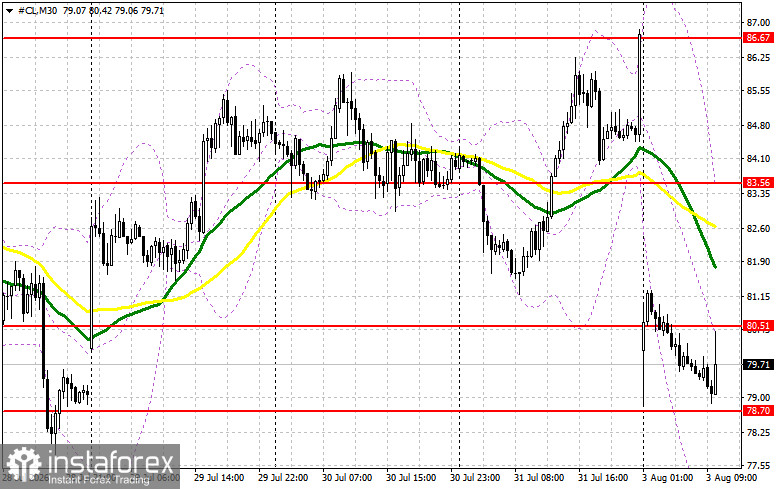
As for the current technical picture of oil, buyers need to overcome the nearest resistance at $80.51. This would allow targeting $83.56, above which it will be quite challenging to break through. The most distant target will be in the $86.67 range. In the event of a price decline, bears will attempt to take control at $78.70. If they succeed, a breakdown of this range could deal a serious blow to bulls' positions and push oil down to a low of $76.30, with the possibility of reaching $73.80.


