
यह भी देखें


 05.03.2026 08:16 AM
Bitcoin experienced a sharp price increase yesterday, reaching $74,000. Ethereum also significantly gained, stabilizing above the $2,100 level.
According to the latest data from CryptoQuant, there is a troubling yet encouraging trend: inflows of Bitcoin onto exchanges have significantly decreased, while purchases of the asset are steadily increasing. This shift in market dynamics has far-reaching implications, signaling a gradual easing of the selling pressure on the cryptocurrency market and, consequently, a simultaneous increase in demand.

The reduction in the volume of BTC entering trading platforms serves as a barometer for the decreasing number of coins available for immediate sale. When investors hold their assets off exchanges, it indicates their intention to retain them for the long term, believing in future price increases. This, in turn, reduces liquidity for sellers and limits their ability to exert price pressure.
In parallel, the increased buying activity indicates growing interest in Bitcoin. This heightened demand, combined with limited supply on exchanges, naturally creates conditions for the onset of an upward price trend. Investors likely see the current situation as an opportunity for profitable purchases, anticipating future growth.
Such a combination of factors—decreasing supply and increasing demand—serves as a classic signal of a potential market rally.
As for the intraday strategy in the cryptocurrency market, I will continue to rely on major pullbacks in Bitcoin and Ethereum, anticipating the continuation of a long-term bullish market that has not gone away.
As for short-term trading, the strategy and conditions are described below.
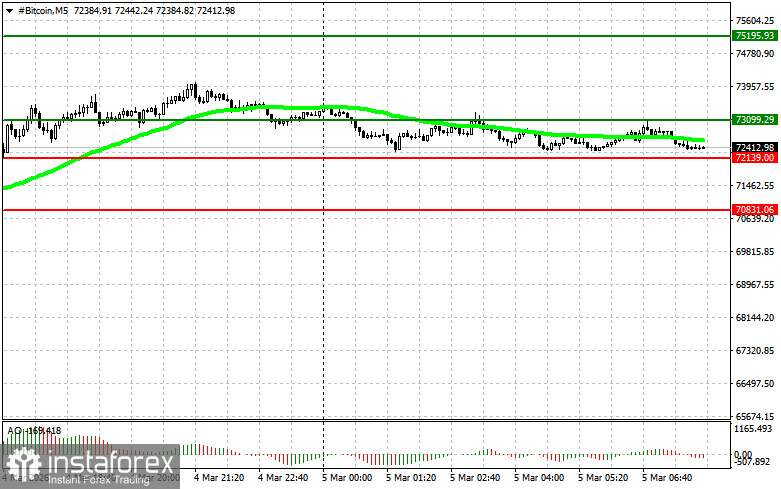
Scenario No. 1: I will buy Bitcoin today if the entry point reaches around $73,000, targeting a price of $75,200. At around $75,200, I plan to exit my purchases and sell immediately on a pullback. Before buying on a breakout, ensure that the 50-day moving average is below the current price and the Awesome indicator is above zero.
Scenario No. 2: I can buy Bitcoin at the lower boundary at $72,100 if there is no market reaction to its breakout back to $73,000 and $75,200.
Scenario No. 1: I will sell Bitcoin today if the entry point reaches around $72,100, targeting a drop to $70,800. At around $70,800, I plan to exit my sales and buy immediately on a pullback. Before selling on a breakout, ensure that the 50-day moving average is above the current price and the Awesome indicator is below zero.
Scenario No. 2: I can sell Bitcoin from the upper boundary at $73,000 if there is no market reaction to its breakout back to levels of $72,100 and $70,800.
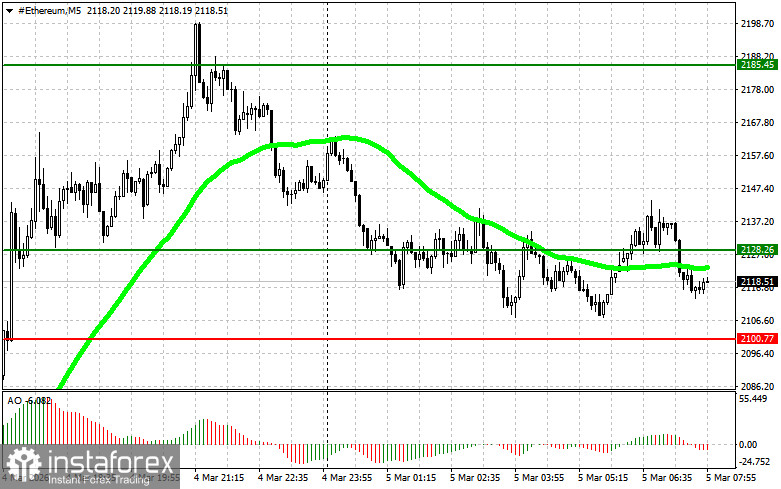
Scenario No. 1: I will buy Ethereum today if the entry point reaches around $2,128, targeting a price of $2,185. At around $2,185, I plan to exit my purchases and sell immediately on a pullback. Before buying on a breakout, ensure that the 50-day moving average is below the current price and the Awesome indicator is above zero.
Scenario No. 2: I can buy Ethereum at the lower boundary at $2,100 if there is no market reaction to its breakout back to $2,128 and $2,185.
Scenario No. 1: I will sell Ethereum today if the entry point reaches around $2,100, targeting a drop to $2,066. At around $2,066, I plan to exit my sales and buy immediately on a pullback. Before selling on a breakout, ensure that the 50-day moving average is above the current price and the Awesome indicator is below zero.
Scenario No. 2: I can sell Ethereum at the upper boundary at $2,128 if there is no market reaction to its breakout back to $2,100 and $2,066.

