
यह भी देखें


 28.08.2026 09:23 AM
Today, Bitcoin has reached yet another peak around $81,500, while Ethereum fell just short, stopping at $2,550. There is currently a renewed struggle for this psychological level.

Meanwhile, according to on-chain analytics regarding the movements of BlackRock wallets, a complete picture is forming that explains the mechanics behind the eight-day influx into the company's spot ETFs. During this period, BlackRock acquired 27,722 bitcoins worth approximately $2.2 billion and 385,633 ethers valued at around $972 million, totaling nearly $3.2 billion in new purchases of both assets. This mirrors the institutional series, where BlackRock's IBIT accounted for up to 62% of the total daily influx into Bitcoin ETFs, confirming that regulated institutional demand—rather than just technical short squeezes—actually translates into real purchases of the asset on the blockchain.
It is noteworthy that these purchases occurred against the backdrop of a noticeably slowing pace of ETF inflows, which dropped from a peak of $606 million on August 20 to $232 million by mid-week. This may indicate that BlackRock continues to systematically buy assets even as retail and some institutional enthusiasm begins to cool, along with a retreat in the fear and greed index from 74 to 65. The company appears to be using this consolidation phase following the sharp August rally to increase its position rather than waiting for new price highs to boost its exposure.
The scale of the accumulated purchases over the past eight days aligns well with the broader picture for the month; as previously reported, total August inflows into Bitcoin ETFs exceeded $3 billion, and the majority of the fund's overall increase in net assets of $22 billion came from the appreciation of Bitcoin already held, rather than fresh money inflows.
As for short-term trading, the strategy and conditions are outlined below.
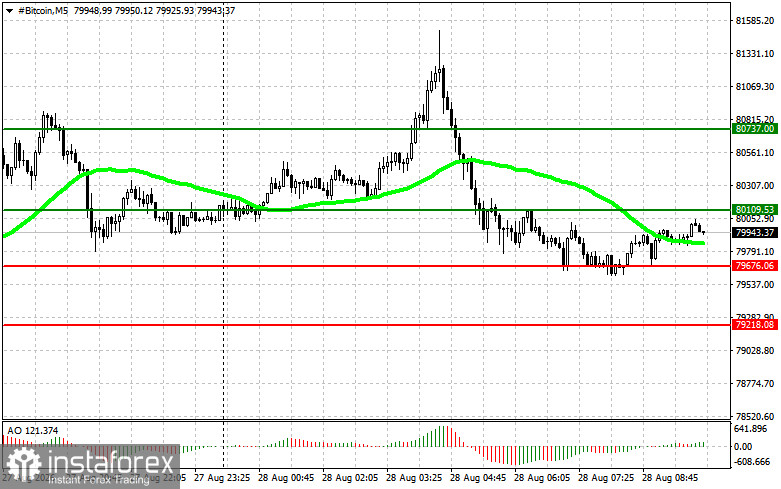
Scenario No. 1: I plan to buy Bitcoin today when the entry point reaches around $80,100, with the aim of rising to the level of $80,700. At $80,700, I will exit the buy positions and sell immediately on the rebound. Before buying on the breakout, ensure that the 50-day moving average is below the current price and the Awesome indicator is above zero.
Scenario No. 2: Bitcoin can be bought at the lower boundary of $79,600 if there is no market reaction to its breakout in the opposite direction to levels of $80,100 and $80,700.
Scenario No. 1: I plan to sell Bitcoin today when the entry point reaches around $79,600, with the aim of falling to the level of $79,200. At $79,200, I will exit the sell positions and buy immediately on the rebound. Before selling on the breakout, ensure that the 50-day moving average is above the current price and the Awesome indicator is below zero.
Scenario No. 2: Bitcoin can be sold from the upper boundary of $80,100 if there is no market reaction to its breakout in the opposite direction to levels of $79,600 and $79,200.
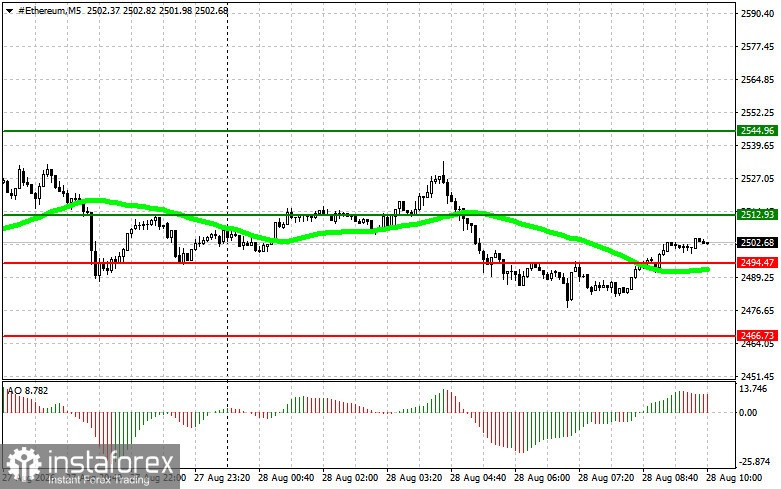
Scenario No. 1: I plan to buy Ethereum today when the entry point reaches around $2,512, with the aim of rising to the level of $2,544. At $2,544, I will exit the buy positions and sell immediately on the rebound. Before buying on the breakout, ensure that the 50-day moving average is below the current price and the Awesome indicator is above zero.
Scenario No. 2: Ethereum can be bought at the lower boundary of $2,493 if there is no market reaction to its breakout in the opposite direction to levels of $2,512 and $2,544.
Scenario No. 1: I plan to sell Ethereum today when the entry point reaches around $2,493, with the aim of falling to the level of $2,466. At $2,466, I will exit the sell positions and buy immediately on the rebound. Before selling on the breakout, ensure that the 50-day moving average is above the current price and the Awesome indicator is below zero.
Scenario No. 2: Ethereum can be sold from the upper boundary of $2,512 if there is no market reaction to its breakout in the opposite direction to levels of $2,494 and $2,466.

