
यह भी देखें


 23.09.2026 12:24 PM
Review of Trades and Trading Advice for the British Pound
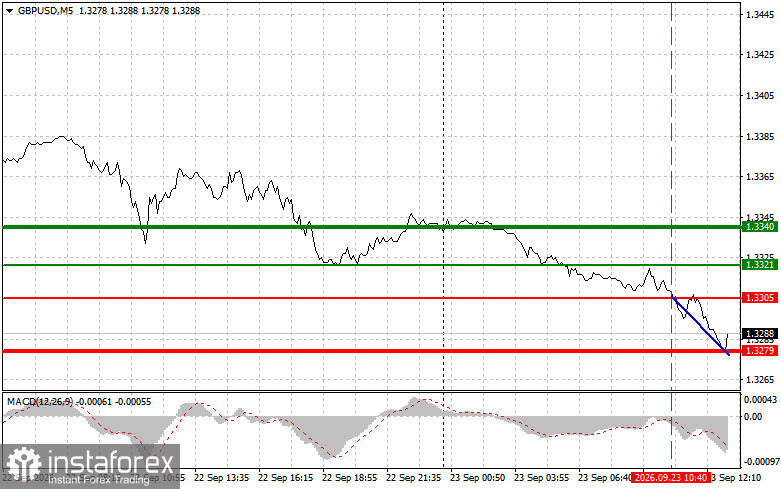
The price test of 1.3305 occurred when the MACD indicator had just started moving down from the zero line, confirming the validity of the entry point for selling the pound. As a result, the pair declined toward the target level of 1.3279.
The September preliminary UK PMI was clearly disappointing: the composite index fell to 51.7 points from 52.5 in August, reaching a three-month low, while the manufacturing sector fell to a six-month low. However, the main deterioration in the overall picture came from the services sector, where export orders declined and employment continued to fall for the second consecutive year, highlighting that the problem is structural rather than temporary. In my view, the sustained weakness in services, rather than the one-off deterioration in manufacturing, was the main reason for the pressure on GBP/USD today. The services sector accounts for the largest share of the UK economy, and its prolonged weakness is traditionally viewed by the market as a more concerning signal than fluctuations in manufacturing. Combined with the already established hawkish backdrop from the Federal Reserve, this data leaves the pound with very little room for maneuver, and I would not rule out the possibility that, without offsetting positive signals, the pair will continue to seek new support levels in the coming days.
In the second half of the day, market attention will shift to U.S. PMI data — preliminary figures for the manufacturing and services sectors, as well as the composite index, which appear likely to continue showing solid growth in business activity. In my view, strong data could trigger renewed dollar buying, especially against the backdrop of the consensus that has developed among Fed officials in recent days in favor of further monetary policy tightening. An additional factor will be a speech by Federal Reserve Governor Michael Barr, whose rhetoric could further reinforce this stance and appeal to traders betting on a stronger dollar.
As for the intraday strategy, I will focus more on the implementation of Scenarios No. 1 and No. 2.
Buy Signal
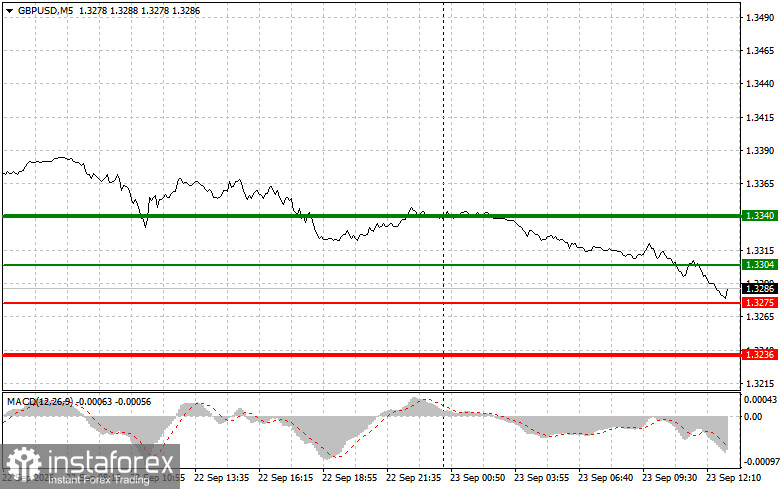
Scenario No. 1: Today, I plan to buy the pound when the entry point is reached around 1.3304 (the green line on the chart), targeting a rise toward 1.3340 (the thicker green line on the chart). Around 1.3340, I will exit the long position and open short positions in the opposite direction (targeting a move of 30–35 points in the opposite direction from the level). A rise in the pound today can only be expected if the U.S. data is very weak. Important! Before buying, make sure that the MACD indicator is above the zero line and has only just started rising from it.
Scenario No. 2: Today, I also plan to buy the pound if there are two consecutive tests of the 1.3275 price level while the MACD indicator is in the oversold zone. This will limit the pair's downward potential and trigger a reversal to the upside. A rise toward the opposite levels of 1.3304 and 1.3340 can be expected.
Sell Signal
Scenario No. 1: Today, I plan to sell the pound after the 1.3275 level is updated (the red line on the chart), which will lead to a rapid decline in the pair. The key target for sellers will be 1.3236, where I will exit the short position and immediately open long positions in the opposite direction (targeting a move of 20–25 points in the opposite direction from the level). Strong pressure on the pound may return at any time. Important! Before selling, make sure that the MACD indicator is below the zero line and has only just started falling from it.
Scenario No. 2: Today, I also plan to sell the pound if there are two consecutive tests of the 1.3304 price level while the MACD indicator is in the overbought zone. This will limit the pair's upward potential and trigger a reversal to the downside. A decline toward the opposite levels of 1.3275 and 1.3236 can be expected.
What Is Shown on the Chart:
Important. Beginner Forex traders need to exercise great caution when making decisions about entering the market. Before the release of important fundamental reports, it is best to stay out of the market to avoid exposure to sharp exchange-rate fluctuations. If you decide to trade during news releases, always place stop orders to minimize losses. Without stop orders, you can lose your entire deposit very quickly, especially if you do not use proper money management and trade with large volumes.
And remember that successful trading requires a clear trading plan, such as the one presented above. Making spontaneous trading decisions based on the current market situation is an inherently losing strategy for an intraday trader.

