
Lihat juga


 08.04.2026 12:49 AM
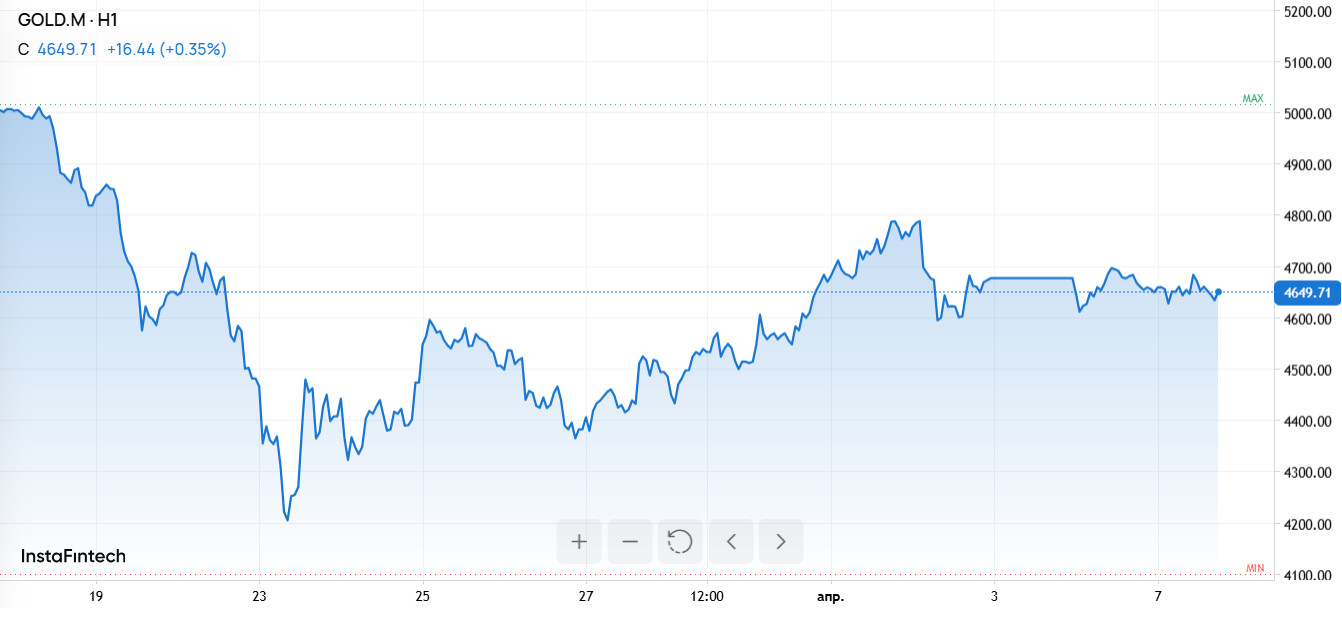
On Tuesday, gold futures prices rose during the European session amid ongoing reassessment of geopolitical risks and dollar dynamics. However, the market movement appears more "technical," with noticeable volatility and conflicting macroeconomic signals.
On COMEX (part of the New York Mercantile Exchange), June gold futures are trading at $4,685.62 per troy ounce. The session's peak was $4,825.90 per ounce. Meanwhile, gold seems to have found support at $4,580.40, while resistance is capped at $4,825.90—this is particularly important for traders focused on breakouts and bounces from key levels.The futures contract for the USD index, which reflects the U.S. dollar's dynamics against a basket of six major currencies, decreased by 0.04% and is trading around $99.76. A declining index typically supports precious metals, but the pace of gold's recovery remains limited due to ongoing pressure on risk assets and rate expectations.
Amid gold, investors also evaluated the dynamics of related instruments:Weakness in silver and copper highlights that demand for metals remains uneven: gold is supported in part by structural factors, while industrial components react to market sentiment and dollar movements.
One of the most significant factors remains the behavior of official demand. According to Bloomberg, the People's Bank of China purchased the largest amount of gold in over a year in March, reaffirming China's role as a cornerstone of demand for the metal, especially amid pressure on gold from the war in the Middle East.
According to data released on Tuesday, China's gold reserves increased by 160,000 troy ounces (approximately 5 tons). It is noted that purchases have been ongoing for 17 consecutive months—this strengthens the signal of strategic accumulation.
Additionally, it was reported that:
In March, gold fell by 12%, marking the worst monthly result since 2008. Pressure intensified amid a strengthening dollar and concerns that the Fed might delay rate cuts amid a spike in inflation. The metal was also impacted by sell-offs, as some investors sold assets to cover losses in other markets.
As of Tuesday, spot gold is trading nearly unchanged at around $4,655 per ounce. At the end of January, prices nearly reached a record, stopping just below the $5,600 level.
There is growing concern in the market that gold sales by central banks could be a factor contributing to further declines. Moreover, in the scenario of a prolonged conflict in the Middle East, some participants suggest that central banks may face a combination of sharply rising inflation, falling economic growth, and currency devaluation, necessitating the liquidation of part of their reserves.
For example, in March, the Central Bank of Turkey sold and exchanged (through swaps) about 60 tons to support the lira.
At the same time, UBS strategist Joni Teves believes that "it is extremely unlikely that a structural shift has occurred in the official sector trend." His forecast is that the global official sector will acquire between 800 and 850 tons of gold this year, which is only slightly below the approximately 860 tons bought in 2025. Teves assesses that no sustainable structural turnaround is in sight.
He also notes that periodic sales by individual central banks are possible—more frequently in conditions where central banks accumulate reserves under relative stability rather than "chasing" a declining market.


