
Lihat juga


 11.06.2026 12:54 PM
The Bank of Canada kept its key overnight interest rate unchanged at 2.25%, fully in line with market expectations. The overall tone of the statement and Governor Macklem's opening remarks at the press conference were neutral. The Bank has shifted into a monitoring mode, avoiding abrupt policy moves and aiming to gain a clearer understanding of key risks affecting the inflation outlook. As a result of the meeting, the market received no new information, which was reflected in a muted reaction.
The Bank of Canada's decision came against the backdrop of first-quarter GDP data showing the onset of a technical recession. Clearly, this factor could not be ignored. In such conditions, a rate hike would be illogical; however, a rate cut is also not possible due to the persistent high risk of rising inflation.
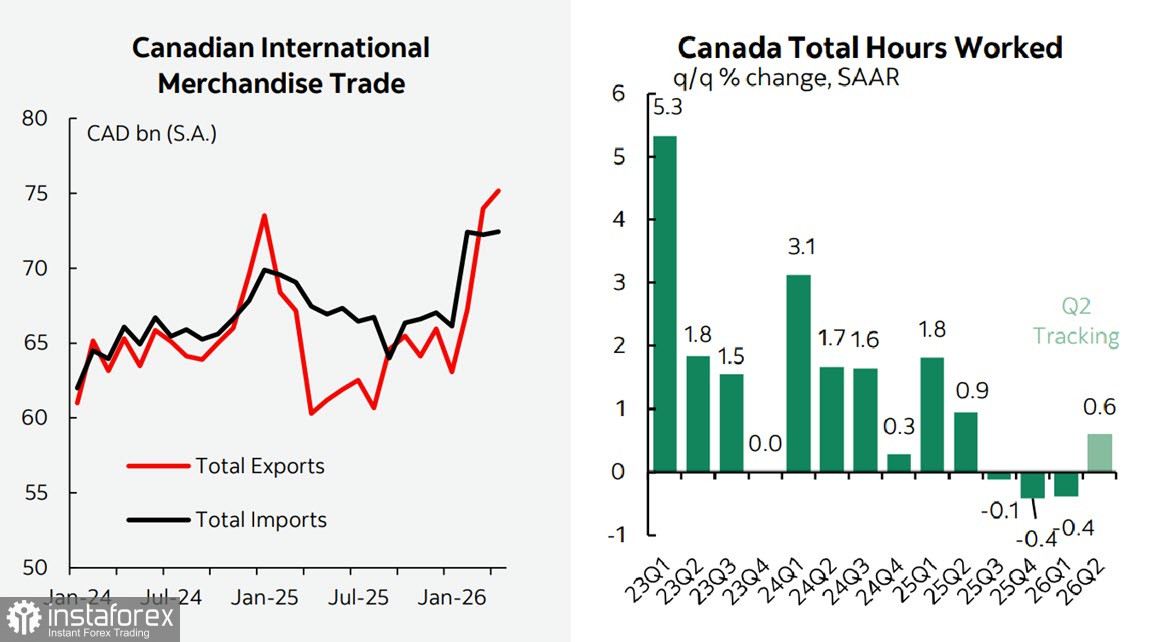
Other Canadian economic indicators also did not require immediate policy action. The May labor market report was notably strong, with 88,000 new jobs created, significantly exceeding analysts' expectations of 10,000. The unemployment rate fell from 6.9% to 6.6%, as employment growth outpaced labor supply. Average hourly wages increased by 3.0% year-over-year in May, down from 4.5% in April, which can also be viewed positively from an inflation containment perspective.
This strong report allowed the Bank of Canada to reaffirm the validity of its current strategy of inaction. Preliminary GDP data for April showed growth of 0.4%, and the strong labor market figures suggest that economic activity may recover in the second quarter.
Canada's trade balance in April also showed positive dynamics, posting a surplus of CAD 2.7 billion compared to CAD 1.8 billion in the previous month. Rising oil prices contributed, but strong performance in other export categories should also be noted. The trade surplus with the United States also increased, indicating that concerns over trade conditions initiated last year by Trump-era tariff increases have not had a significant impact on the Canadian economy.
At present, it can be assumed that sustained economic recovery is necessary for meaningful strengthening of the Canadian dollar. However, there are still limited grounds for such momentum.
The net short position in CAD increased over the reporting week by 1.81 billion to -6.8 billion. The bearish bias is strengthening, with the fair value price above the long-term average and continuing to rise.
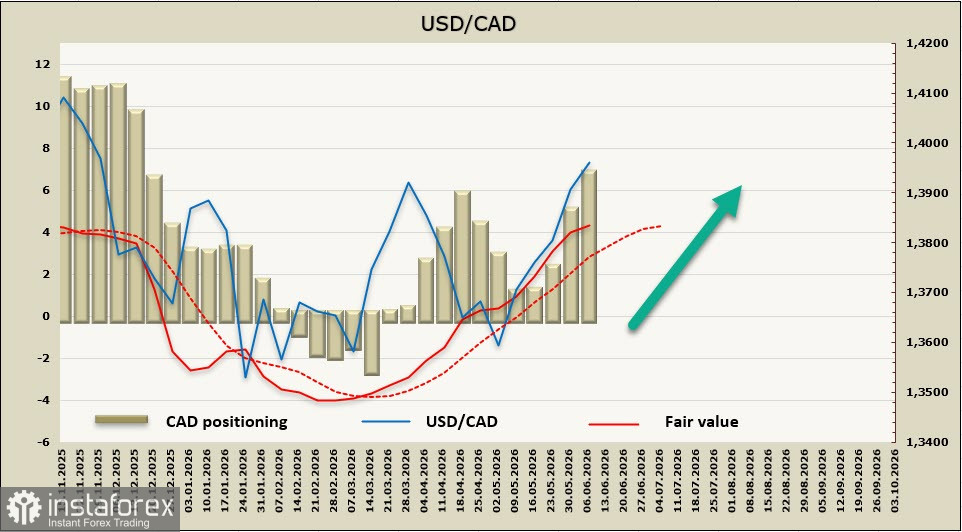
USD/CAD reached the resistance level of 1.3930–1.3965, which was identified in the previous review as the primary target. The trend remains bullish. From a technical perspective, after an attempt to break above 1.3965, a minor pullback is possible, which could be used for new long positions. However, a more likely scenario is a firm break above 1.3965 and a continuation toward the next target at 1.4139.


