
Vea también


 21.09.2026 03:26 PM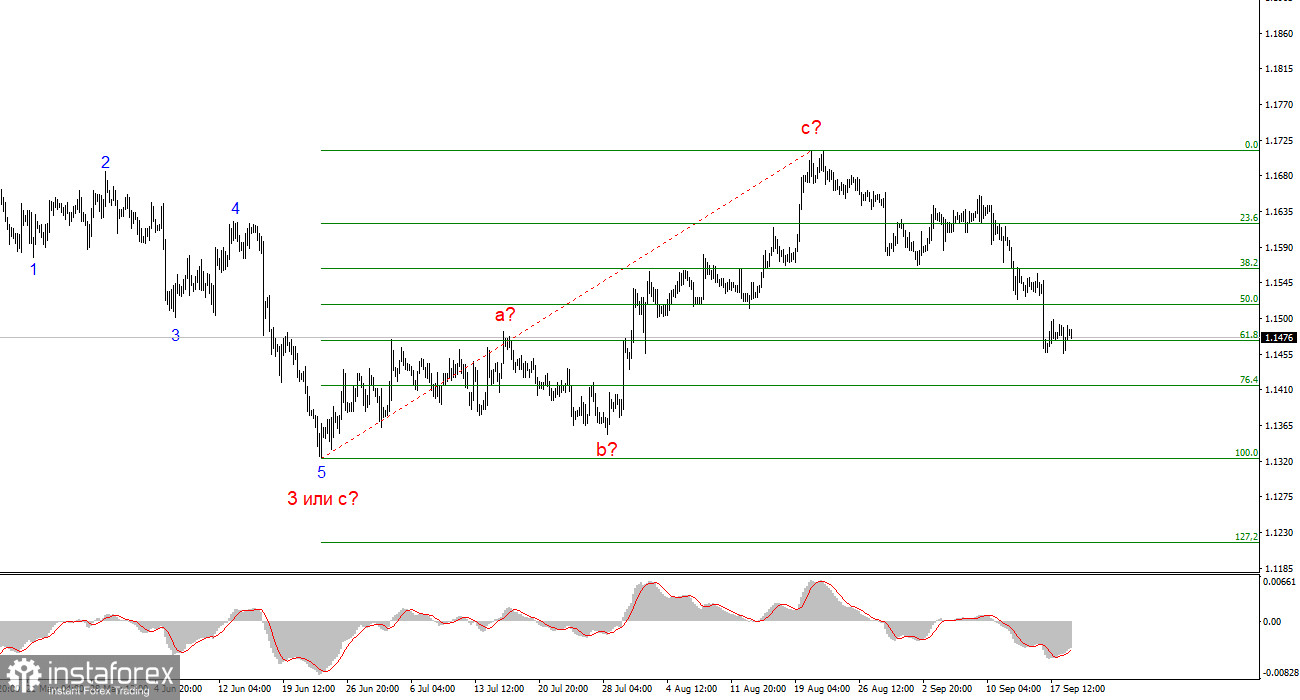
The wave structure on the 4-hour chart for EUR/USD is becoming more complex. There is still no question of invalidating the upward trend segment (lower chart), which began in January last year. On the contrary, we have seen a full corrective A-B-C structure that may have been completed. However, recent events related to the Federal Reserve and its policy have once again affected the current wave structure. Let me remind you that the news background and wave structure often conflict with each other, making adjustments necessary.
The wave structure may now once again develop into a more complex formation. Wave C has taken a three-wave form, while the next wave is identified as wave D. The entire trend segment that began on January 27 may now take a five-wave corrective form, A-B-C-D-E. If this assumption is correct, wave D is complete, and on August 21, EUR/USD entered the phase of forming wave E, whose low should be below the low of wave C at 1.1325. The only question now is whether the news background will support the dollar sufficiently for the pair to fall below 1.1325.
The Fed Meeting Changed the Market's View of the Dollar
The EUR/USD pair was virtually unchanged on Friday, while the range of price movements returned to its usual minimal levels. By and large, the market focused on only one event last week—the Federal Reserve meeting. All other events were either ignored or received only limited attention from market participants. The Bank of England meeting is clear evidence of this. Despite the fact that the British regulator also adopted a relatively hawkish stance, this provided no support for sterling.
The most important point, from my perspective, is that the market demonstrated that, in the near term, it is prepared to make decisions based only on global factors. At the same time, the monetary policy of the ECB or the Bank of England is not among these factors. Essentially, everything currently comes down to two issues: developments in the Middle East conflict and the Federal Reserve's monetary policy. These two factors, it should be noted, offer relatively favorable prospects for the dollar. To begin with, the conflict in the Middle East is continuing, and I see no signs that it is being resolved. Donald Trump could well opt for further escalation. At this point, the best-case scenario for the global community is for an escalation to occur, but at least not now, but after the U.S. congressional elections. Following the elections, the balance of power in the U.S. Congress could change significantly, so any escalation could be considerably less severe than it might be if Trump retained full control of the country. Therefore, however it may sound, the world needs the Republicans to lose the elections.
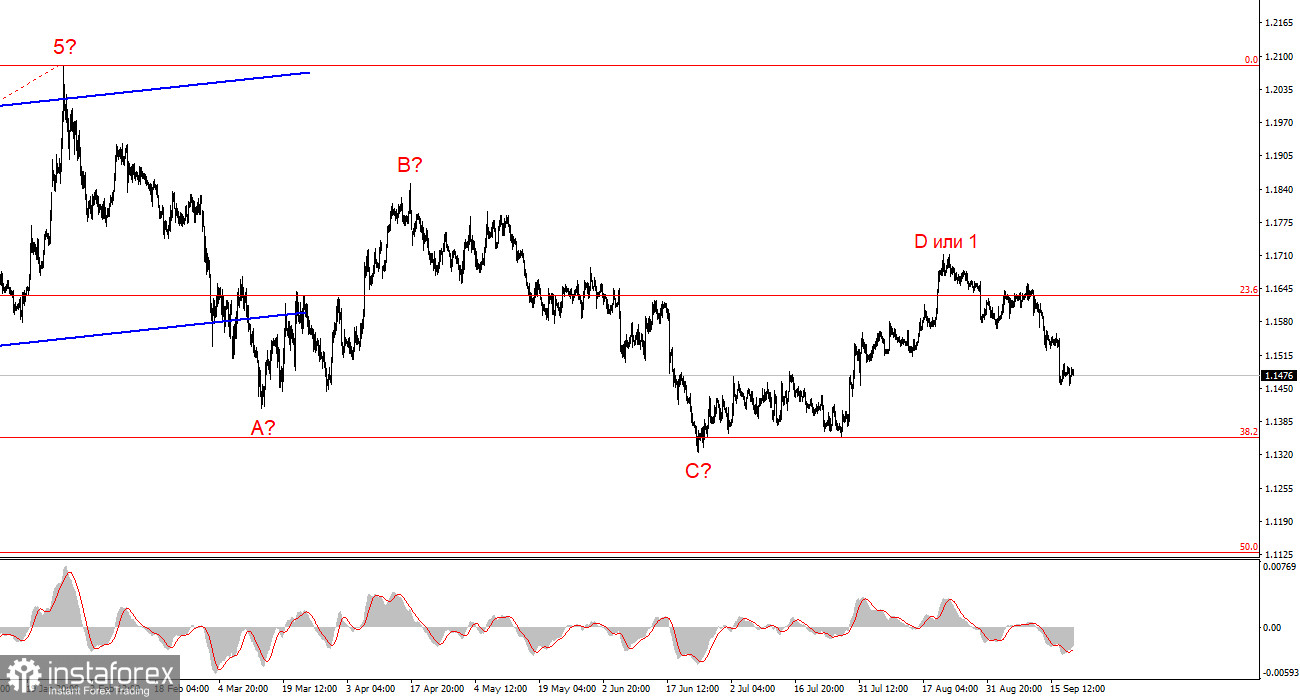
Based on my analysis of EUR/USD, I conclude that the pair remains within the global corrective A-B-C-D-E trend segment. If this assumption is correct, the decline will continue toward targets below the low of wave C at 1.1325. I previously considered this scenario an alternative one, and without the Federal Reserve meeting, it would have remained a reserve scenario. However, the Fed delivered a surprise, leaving the market with no other option but to initiate a new wave of U.S. dollar purchases. At the same time, however, further dollar appreciation requires new catalysts. I do not see any such catalysts at the moment. Therefore, a new upward, non-corrective wave may begin from the current levels.
On the higher timeframe, an upward trend segment is visible, followed by the formation of an A-B-C corrective structure. This structure could develop into a five-wave formation, but at present I consider it complete. If so, a new impulsive upward trend segment has begun to form.
The Main Principles of My Analysis:


